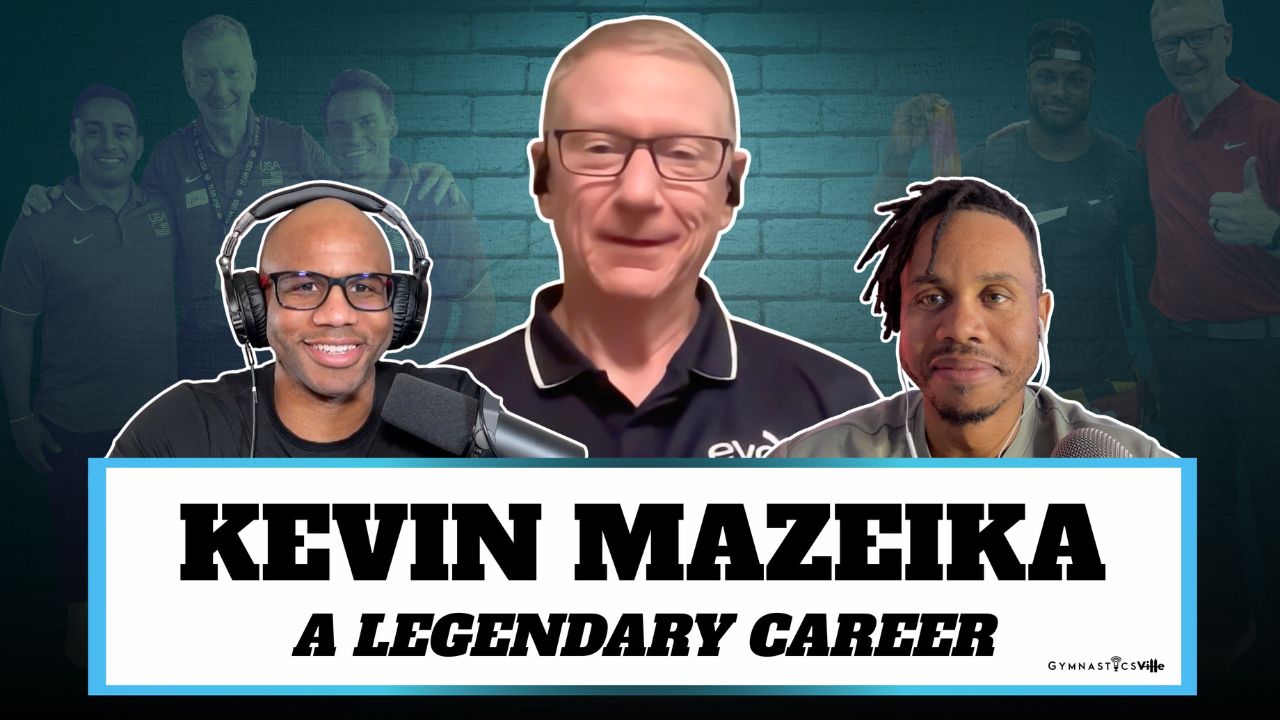
Kevin Mazeika on GymnasticsVille Podcast: Olympic Gold, EVO Gymnastics, and Why He Believes Team USA Can Win at LA 2028
By Mubarak Simmons,
When Kevin Mazeika agreed to sit down with us for Episode 2 of the GymnasticsVille Podcast, he made one thing clear: this was his first long-form podcast interview. Ever. After more than four decades in gymnastics, three Olympic cycles as U.S. Men’s Head Coach, a Hall of Fame induction, and now back-to-back World Championship gold medals out of EVO Gymnastics, he finally decided it was time to tell his story.
We talked for one hour and 47 minutes. It wasn’t enough.
The conversation covered the 2025 World Championships in Jakarta, the historic 2004 Athens silver medal, the near-disaster at the 2001 Worlds three weeks after 9/11, what Kevin built at EVO Gymnastics in Sarasota, his coaching philosophy, and a bold belief that Team USA can win team gold at LA 2028. For me and my brother Taqiy, both former athletes Kevin coached in Houston, this episode was two decades in the making.
Where It All Started: Southern Illinois and the Coach Who Shaped Him
Before the Olympic medals, before the Hall of Fame induction, before EVO Gymnastics, there was Southern Illinois University and a coach named Bill Meade.
Kevin competed at SIU from 1980 to 1984 under one of the most decorated coaches in the history of NCAA men’s gymnastics. Meade guided the Salukis to four NCAA Division I National Championships and his teams went seven straight years without losing a dual meet, winning 68 consecutive meets from 1961 to 1968, a streak that still stands as the longest in SIU history. Kevin has spoken openly about feeling honored when Meade recruited him and about adapting many of Meade’s lessons directly into his own coaching career.
What Kevin absorbed at SIU became the foundation for everything he built as a coach. He told us on the podcast about Meade leaving a teammate behind for being late to the team van on his very first road trip as a freshman. No second chances, no exceptions. Those were the standards. Kevin never forgot them. That accountability and respect for the team over the individual shows up in everything Kevin has built since.
This April, that legacy gets its formal recognition. Bill Meade is being inducted into the 2026 College Gymnastics Association Hall of Fame on Saturday, April 18 at the University of Illinois.
It is a full-circle moment. The coach who shaped Kevin Mazeika is finally getting his recognition, and the coach Kevin became speaks directly to the lessons Meade planted decades ago in Carbondale.
Two World Championship Gold Medals Out of One Gym
We opened the episode talking about what just happened at the 2025 World Championships in Jakarta. Brody Malone won gold on high bar. Donnell Whittenburg won gold on still rings, becoming the first American man in history to win a World Championship title on that event. Both train at EVO Gymnastics under Kevin’s direction.
Two gold medals. One gym. Seven gold medals were awarded at those World Championships. EVO took two of them.
Kevin was characteristically measured when I asked him about it. He talked about preparation, the refinement process, and creating what he calls “a work of art” rather than simply executing a routine. What stood out was what he said about Brody specifically. His belief was so strong it carried him through a difficult training build, and he peaked at exactly the right moment.
The high bar final had a genuine decision point. Brody’s Winkler wasn’t credited in the preliminary round. Kevin and EVO head coach Syque Ceaser went back and forth on whether to attempt the triple pike as a replacement or stay with the Winkler and execute it cleanly. The call: stay with the Winkler and keep it straight. Brody went first in the final, hit an immaculate routine, and watched his score hold for the rest of the competition.
Donnell’s path was different. He had only moved to EVO in March 2025, just months before the World Championships. He arrived recovering from an Achilles injury with a significant learning curve ahead of him. But Kevin described him as “all in from day one.” The refinement came. The handstands got cleaner. His rings routine, already among the most difficult on the planet, became a finished piece. Kevin laughed telling us that Donnell’s warm-up layout double-double was landing straight up and down, overrotated. The guy trains like it’s his last day every single day.
2001 Worlds: 9/11, a Terrible Practice, and a Moment That Changed U.S. Men’s Gymnastics
Before we could get to Athens, we had to go to Ghent. The 2001 World Championships is where Kevin believes the foundation for everything that followed was actually built.
The backdrop was unlike anything in modern sports history. The September 11 attacks happened the same month as the competition. The U.S. State Department initially said no American teams would travel internationally. The gymnastics team was in limbo, training and not training, unsure whether they would even go. Then, the day before departure, they got the call: you can go.
“All of a sudden everything shifts,” Kevin told us. “When you have it taken away from you, and then you get it back, it was full-on gratitude. We get to go. We get to do this.”
They arrived in Belgium, had two good workouts, and then two days before competition had one of the worst practices Kevin had ever seen. Nobody could hit anything. He got back to the hotel room with his coaching staff and they sat there asking each other what they were going to do. His answer: trust the process. They believed in the preparation. They stayed on their path.
The team went out and competed. Sean Townsend won gold on parallel bars, the first individual World Championship gold for an American man since 1979. The team won silver, the first world team medal since 1979 as well. Kevin described the impact simply: “When Sean won, it was like, okay, we can do this. The possibility was there.”
Taqiy put it perfectly in the episode. That gold medal, won in the shadow of 9/11, on foreign soil, after a terrible pre-competition workout, was the moment American men’s gymnastics truly started to believe. Everything that followed in 2003, 2004, and beyond was built on that foundation.
Athens 2004: The First Non-Boycotted Olympic Medal Since 1932
The 2004 Athens Olympics remain one of the defining moments in U.S. men’s gymnastics history. Team silver. The first men’s team medal in a non-boycotted Olympics since 1932. Kevin was the head coach.
He talked about the formula he developed heading into that quadrennium: Goals, Motivation, Vision, Action. He pushed the athletes to go deeper than simply wanting a medal. What’s below that? Making history. Inspiring the next generation. Competing for your country and for each other. Those were the motivations that grounded the team through the hardest training cycles.
Kevin also credited the compression of talent in that era. Sean Townsend, Todd Thornton, Yewki Tomita, and Jason Gatson were young athletes pushing up against the established names of Paul and Morgan Hamm, Blaine Wilson, and others. Nobody’s spot was safe. Everybody got better because of it. Kevin described it as a battle-tested group forged through multiple World Championships before they ever strapped on bar grips in Athens.
He also shared a story from a dual meet against China in 2003. Walking into the venue and watching Li Xiaopeng hit vaults. Then Yang Wei. Then someone else. One after another, impossible vaults. His response: “All right boys, let’s get to work.” The attitude wasn’t intimidation. It was motivation. That is the 2004 team in a single anecdote.
EVO Gymnastics: The Clean Slate
Kevin moved to Sarasota to build EVO Gymnastics from the ground up. He described it as a once-in-a-lifetime opportunity to do things exactly the way he believed they should be done. No inherited culture, no compromises, a true clean slate.
The first thing he built wasn’t the training program. It was the staff culture. His early coaches meetings had zero gymnastics content. Instead, he went around the circle and asked each coach what they were personally working on, not technically, but as human beings. He modeled it himself. “I’m working on procrastination. I need accountability.” Once he was vulnerable, everyone else opened up. Trust was built. From that trust, a coaching staff emerged that could have genuinely difficult technical debates while maintaining total respect and alignment on what mattered most: the athletes.
The results are documented. Two World Championship golds in 2025. Stephen Nedoroscik’s bronze on pommel horse at Paris. The EVO model is working.
Surrender to Win
Near the end of the episode, I asked Kevin about a phrase he has used throughout his career: “surrender to win.” It sounds paradoxical. That’s the point.
Kevin explained it this way: whatever you resist, persists. If you don’t like doing circles on pommel horse, you’ll keep resisting them and they’ll never improve. Surrender isn’t giving up. It’s letting go of the resistance. It’s fully accepting what you need to work on and committing to it without hedging, without ego, and without the “I always” and “I never” self-talk that caps an athlete’s potential before they ever really start.
He gave a concrete example from 2013. Brandon Wynn had an inter-squad before Worlds and scored poorly on execution. Rather than defending his routine, he walked up to the judge and said: “Tell me every single thing I need to work on.” He spent the next month attacking that feedback without complaint. That is surrender to win. It led directly to a World Championship medal.
Kevin applies this equally to coaches. Self-evaluation is non-negotiable. You cannot avoid your weaknesses any more than your athletes can. The coaches who grow are the ones who continually study, seek mentors, stay open to being wrong, and show up as the best version of themselves both in the gym and outside of it.
“I Really Do Think We Can Do It”: Kevin’s LA 2028 Prediction
When the conversation turned to LA 2028, Kevin didn’t hedge. The last time Team USA won Olympic team gold was 1984 in Los Angeles. Now the Games return to the same city. The symmetry isn’t lost on him.
“It couldn’t be set up more perfectly,” he said. “The last gold was in 1984 in Los Angeles. And here we are, 2028.”
He pointed to the same compression of talent he described from the early 2000s. Young athletes like Fred Richard and Asher Hong have already been to an Olympics and are pushing against veterans who are motivated to hold their spots. He talked about Brody and Donnell’s World Championship golds setting belief the same way Sean Townsend’s 2001 gold did. Winning becomes a habit, he said. Now the expectation exists. Now the door is open.
“I really do think we can do it,” Kevin said. “Is it going to be easy? No. But let’s raise the bar. Let’s keep pushing.”
Coming from a three-time Olympic head coach who has stood on that floor and knows exactly what it takes, that is not wishful thinking. That is a measured, informed belief from someone who has done it before.
Listen to Episode 2
Episode 2 of the GymnasticsVille Podcast with Kevin Mazeika is available now on YouTube. This is Kevin’s first long-form podcast interview, 107 minutes of Olympic stories, coaching philosophy, and genuine insight from one of the most accomplished coaches in American gymnastics history. The episode comes to Spotify and Apple Podcasts on Monday, March 16.
If you missed Episode 1, our conversation with Olympian Yul Moldauer is available on all platforms now.
Follow GymnasticsVille on Instagram for breaking news and live meet coverage.