
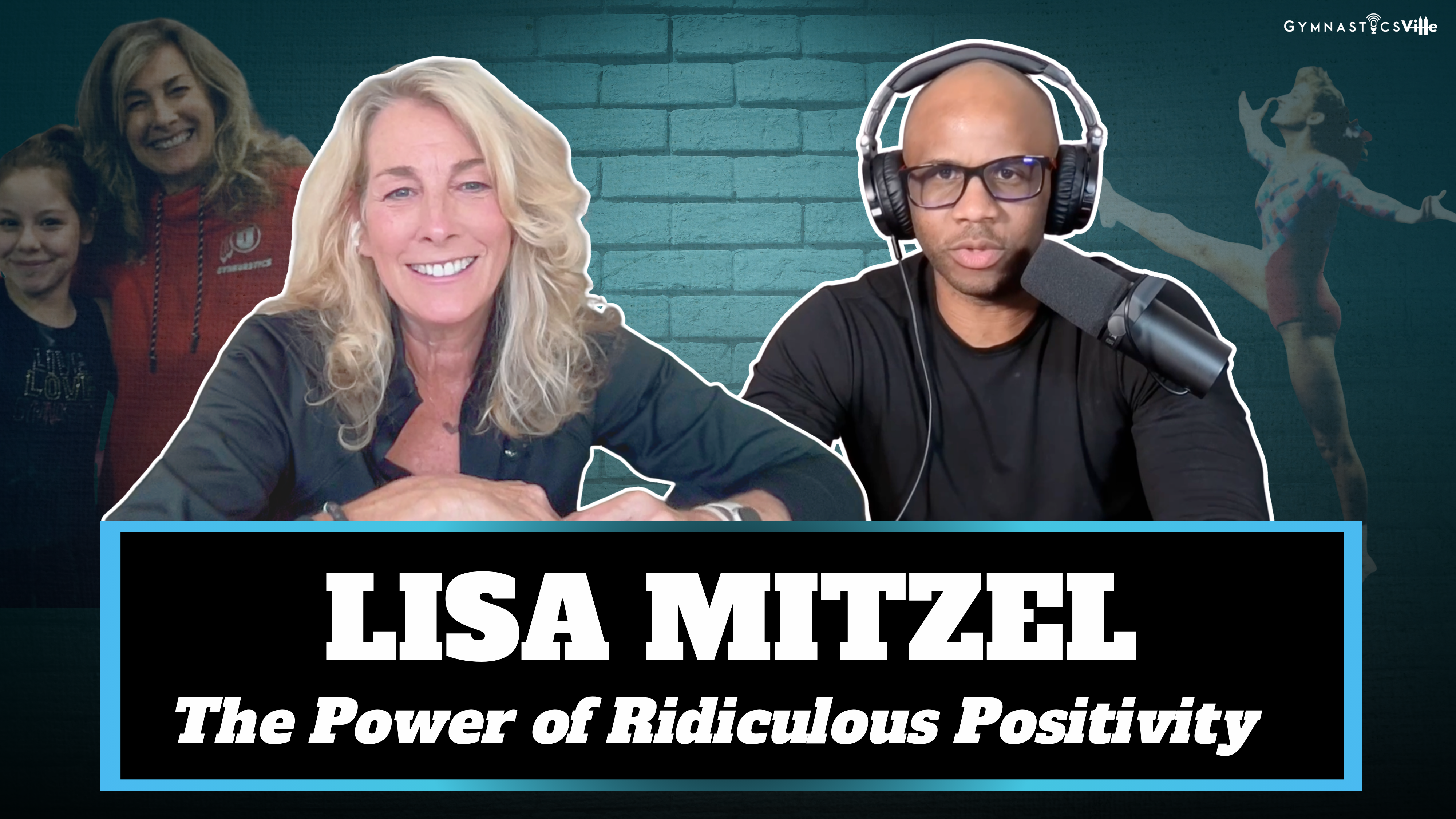
Twelve years old, three falls in warmups, and a side aerial she had already decided to pull out of her beam routine. Then Lisa Mitzel remembered something ridiculous her mother told her in the car, and she stuck it. That moment is where ridiculous positivity began.
Ridiculous positivity is the training method Mitzel now teaches to gymnasts, coaches, and corporate leaders across the country. On this episode of the GymnasticsVille Podcast, she walked through where it came from, what the science says, and how coaches and parents can use it the week competition season begins.
Lisa Mitzel is a four-time NCAA national championship team member and six-time All-American at the University of Utah, a former collegiate coach at Stanford, a published author twice over, and the founder of Zen Tiger Mind. She has spent decades on both sides of the mental performance equation, first as an athlete working weekly with sport psychologists, and now as the person athletes call when the skill is there but the confidence is not.
What Ridiculous Positivity Actually Means
The name sounds like a joke. The definition is not.
“Ridiculous positivity is a training method and daily practice that uses imagination, belief, emotional intelligence to help you see beyond current circumstances, regulate stress, reconnect to joy.”
Lisa Mitzel, mental performance coach and founder of Zen Tiger Mind
Mitzel’s argument is that the absurdity in ridiculous positivity is the active ingredient. When an athlete reaches for something playful instead of something forceful, the body reads it as safety. Safety is what makes risk possible. Tension is what makes risk feel impossible.
She pointed to the 2026 Winter Olympics as a mainstream example. Alysa Liu told the world she did not need a medal, she wanted the stage. Then she performed with exactly the freedom that statement implies. Letting go of the outcome did not cost her the result. It may have produced it.
The Beam Routine That Started It All
Mitzel grew up with six brothers and sisters in a household where belief was practiced the way other families practice a sport. She credits that upbringing with teaching her to suspend the present moment and trust that something good was coming.
Her mother delivered the line that stuck. Driving to a meet, with Mitzel ready to scratch the side aerial she had been missing all week, her mom offered an image: God above the beam, holding the strings, like a marionette.
“Lisa, don’t you know you can’t fall?”
Lisa Mitzel, recalling her mother
Mitzel rolled her eyes. Then she fell three times in the three-minute touch warmup. Sitting in the corral with zero confidence, she gave in to the silly image and thought, fine, whatever, God is holding me up.
She got on the beam calmer than she had been all week, tossed the side aerial without forcing it, and landed on her feet. The rest of the routine followed. Her teammates wanted to know what she had done.
The lesson she took from it is the one she still teaches: let go, and do not force it. The story appears in one of her books under the title “You Can’t Fall.”

Coach the Nervous System, Not Just the Skill
One of the most useful reframes in the conversation was Mitzel’s instruction to coach the nervous system rather than the gymnastics or even the person. Her reasoning draws on the self-compassion research of Dr. Kristen Neff, whose work identifies self-kindness as a foundation of resilience rather than a soft alternative to it. That research sits directly underneath ridiculous positivity.
Her framing cuts against a long-standing instinct in the sport. Many gymnasts, Mitzel included, were raised to believe that being hard on yourself is how you get better. She says the opposite is true. Self-criticism plants doubt, and doubt makes a goal feel out of reach before the athlete has started.
The practical version is a phrase worth writing on a gym wall.
“The human mind and the human body need comfort in order to be resilient.”
Lisa Mitzel
Decide First, Then Do: Beating the Mental Block
Mitzel shared a case that will sound familiar to anyone who has coached through a block. An athlete who had not done a tumbling skill in months told her she might try it on Friday. Her strategy was a stack of conditions: if she slept well, if she had energy, if she felt bouncy, if she felt confident, then she would go for it.
Mitzel replaced every “if” with a decision made in advance. Decide now that Friday goes well. Decide now that you have energy. Decide now that you are doing the skill.
Then she sent the athlete into the next room to dance around and say it out loud. The athlete stopped mid-sentence and called back that it felt very uncomfortable. Mitzel’s answer was that discomfort is the point.
On Friday, the text came in. She did the skill.
Her broader point is that ridiculous positivity is planted in advance, not improvised in the middle of a hard turn. It is a lens the athlete lives through, not a rescue tactic.
Why a Gymnast Suddenly Fears a Skill She Owns
Mitzel named two contributors that coaches can act on immediately.
The first is powerlessness. When an athlete feels she has no say in what happens to her, her brain registers that as unsafe, and an unsafe brain does not take risks. Her phrase for the fix is simple: clarity is kindness.
The second is incomplete visualization. Gymnasts tend to see the takeoff clearly and the landing clearly, while the middle stays blurry because it happens fast. Mitzel’s answer is slow-motion visualization built from the ground up, and her method is deliberately low-tech:
- Have the athlete draw a stick figure through four to six positions of a basic skill
- Add dotted lines showing where the eyes look in each position
- Have the athlete teach the skill back, out loud, in her own words
- Edit that explanation into a short script: punch, reach, tuck, rotate, open, land
- Close the eyes, run the script, and see the whole skill moment by moment
The drawing matters because of who is holding the pencil. The athlete stops being the one receiving instructions and becomes the one in charge. Mitzel presented this approach at Region 2 Congress this year.
Three Sentences Every Coach Can Use Tomorrow
The most immediately usable stretch of the episode came when Mitzel asked the host to say a few lines out loud, one at a time. They are worth repeating here, because they replace the urgency that usually fills that silence.
Say This Instead
“It’s okay that you’re struggling today.”
“I’m here for you.”
“We’ll get back to it tomorrow.”
“I believe in you.”
Mitzel is candid that she has said the wrong thing plenty of times across her own coaching career. Her stated intention for 2026 is to be a channel of love and compassion in sport, and she treats that as a practice rather than a personality trait.
She also offered a reminder that behavior is communication. A coach with hands on hips, head down, sighing, is sending a complete message without saying a word. Athletes absorb it, and some will get harder on themselves preemptively so the disappointment hurts less when it arrives.
For Parents: Every Challenge Is an Opportunity
Mitzel’s guidance for parents centers on a triangle of coach, parent, and athlete, with everyone oriented around what the athlete actually wants. She calls it staying child-centered.
Her core message to nervous parents is that their child is stronger than they think. A missed medal, a missed qualification, a hard season, all of it is survivable and most of it is instructive.
“Every single challenge is an opportunity.”
Lisa Mitzel
She is careful to say this does not mean dismissing a child’s sadness. Be sad. Go get ice cream. The feelings are allowed. What she warns against is the parent’s own nervousness leaking into the athlete, because a relaxed adult tends to produce a relaxed competitor.
Ridiculous Positivity Heading Into Competition Season
Mitzel’s competition prep advice follows the same pattern: name the target, name the steps, then make it fun and let go of the grip.
Her favorite drill is a two-word phrase repeated 10 times a day in a bright tone, including to inanimate objects. Anything is possible. She says the phrase signals expansion to the brain, which boosts creativity and problem solving at exactly the moment most athletes narrow down into worry.
She has receipts. Coaching at Stanford in the 1990s, she had a team chasing a national championship berth the program had reached only once before. Along with the physical preparation, she had the team imagine Tuscaloosa in detail, the food, the people, the landscape, and say out loud 10 times a day that they were going to nationals.
Her answering machine filled up with messages from athletes telling her they would see her in Alabama. They walked into the gym taller. They qualified.
The summary she landed on applies to a Level 7 beam routine and a national championship run equally well: be the champion on the inside first, and make it fun.
Listen to the Full Episode
The complete conversation covers considerably more, including Mitzel’s own mental block after a serious crash at 15, the storytelling exercises she uses to release tension in the gym, and a live coaching moment where she turns the questions back on the host. Watch on YouTube, or listen on Apple Podcasts and Spotify.
For more conversations on the human side of the sport, browse our full podcast archive and our elite gymnastics coverage. If you are following the college season, our NCAA Perfect 10 Tracker is updated weekly.
Where to Find Lisa Mitzel
- Website: LisaMitzel.com
- Instagram: @lisa.mentalperformance
- Facebook: Lisa Mitzel
- Email: heymitz@gmail.com
- Zen Tiger Mind, including her Resilience program
The Takeaway
Ridiculous positivity is not a denial of how hard this sport is. Mitzel has the injuries, the surgeries, the mental blocks, and the four championship rings to prove she knows the cost. What she is arguing is that the hardness does not require harshness, and that an athlete who feels safe, clear, and a little bit playful will take the risk that a tense athlete will not.
As she put it at the close of the episode, make it fun. For a sport that spends ten months a year chasing perfection, that may be the most useful instruction of the season.
By GymnasticsVille Host
Follow GymnasticsVille on Twitter, Instagram, and Facebook for breaking news and live meet coverage.