By Mubarak Simmons,
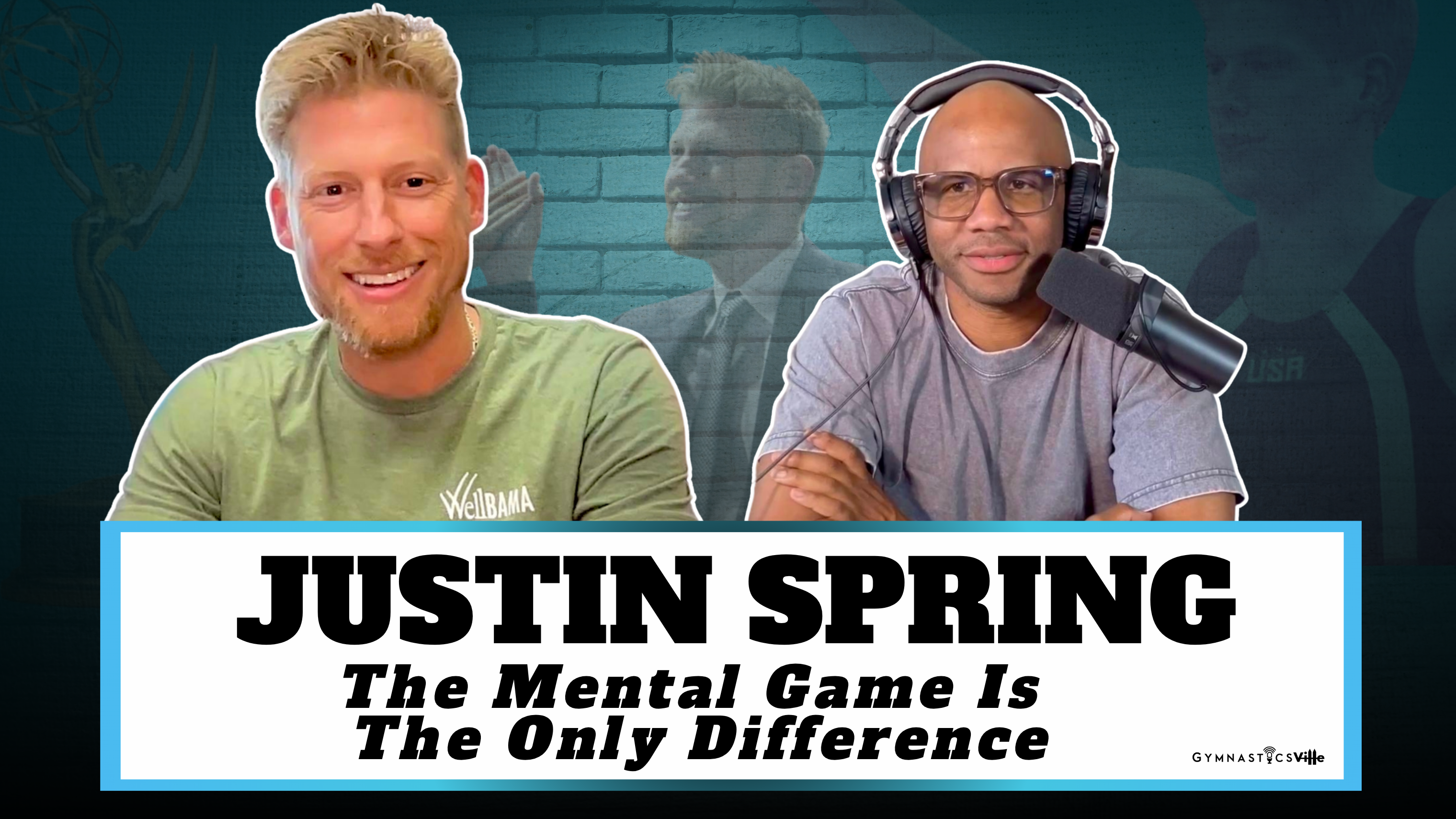
What if the same person who stood on an Olympic podium could also stand behind the microphone calling that very same moment for millions of viewers, then walk into a gym the next season and help build a national championship contender? That is not a hypothetical. That is Justin Spring. On the latest episode of the GymnasticsVille Podcast, the 2008 Olympic bronze medalist, Emmy Award-winning NBC Olympic commentator, and Alabama Gymnastics Associate Head Coach returned to the show for nearly 48 minutes of some of the most candid, quotable, and useful gymnastics coaching conversation of the year.
Alabama Gymnastics Preseason: The Standard Is the Standard
Spring opened the conversation talking about life inside the Alabama program as the 2027 season gets underway. The Crimson Tide are coming off one of the most statistically consistent seasons in the country, scoring above 197.000 in every meet, one of only two programs in the nation to accomplish that alongside Oklahoma. The expectation in Tuscaloosa is a top-four finish at NCAA Championships, and Spring was direct about what that pressure feels like from the inside.
“You’re constantly battling that paradigm. I want to win. I don’t need to win. But also defining your win completely differently.”
Justin Spring, Alabama Associate Head Coach
Alabama enters 2027 with nine freshmen and a returning group that Spring says is hungry to build on last year. The vault rotation took a hit after losing several 10.0 start-value vaults, and beam and floor are areas he expects to see significant growth. He also talked about the experience of coaching inside Coleman Coliseum, which drew the third-highest attendance in NCAA gymnastics last year.
“I was a coach on the floor at a sellout against Auburn. Literally, Beijing Olympics was the last arena I was at that had gymnastics fans like that. And that was just a dual meet.”
Justin Spring
Culture Transformation Takes Time
One of the most shareable moments of the episode came when Spring pushed back on the idea that culture change can be rushed. He compared modern athletes to people living in a microwave society, expecting rapid results from processes that require months and years of daily investment.
A single workshop does not build a championship culture, he explained. A single conversation does not rewire a negative pattern. Spring was direct: you can give athletes the tools, but they have to pick them up every single day and apply them with curiosity and without expectation, or the work will not hold.
Calling the Paris Olympics for NBC
The backstory behind Spring’s NBC gig is one of the best stories in the episode. What he thought was a casual conversation with a producer turned into a live on-air audition when Rich Lerner cued up footage from the previous year’s U.S. Championships and told him to call it in real time. He did. NBC liked it. He was going to Paris.
His broadcast preparation hit a wall three days before the Games, at podium training. Spring kept asking Tim Daggett who various gymnasts were, and Daggett would pull out one of three fully annotated binders and answer in seconds. Spring went back to his room that night and realized he was not ready to commentate the Olympics live. He built his own prep book across three screens and an iPad, session by session, until he was.
During the actual broadcast he described managing a producer in one ear, a conversation with Rich Lerner, analyst notes coming in, inner monologue running, and the expectation that none of that noise would be audible on air.
“It is insane. There is so much happening at once and you have to sound like none of it is happening.”
Justin Spring, on calling the Paris Olympics live
The Full-Circle Paris Moment
The most emotional moment of the episode came when Spring described watching the U.S. men’s gymnastics team win bronze in Paris, the first U.S. men’s team medal since Beijing 2008, the exact year Spring won his. He was in his NBC shirt. He ran down to the arena floor. He was crying.
“It felt exactly like what we did in 08. We went down there and just had a party. We were scared out of our minds, but we connected and bonded, and we said, we’re going to run it our way. And we looked up and we landed on the podium just like those guys did.”
Justin Spring, on the U.S. men’s bronze at Paris 2024
Spring also shared the untold story of Sasha Artemev at the 2008 Beijing team finals. Tasked with only pommel horse, Artemev spent the entire competition in the back gym completing warmup routine after warmup routine while the team cycled through events. He came out between rotations, checked the scoreboard, and went back in. By the time he walked out to compete, he had done 14 warmup routines. He then delivered the performance that helped secure the medal.
The Mental Game Is the Only Difference
Spring saved his most important thesis for the close of the episode. Come postseason, he argued, almost every top-30 team in the country can physically do its best gymnastics. The bodies are trained. The skills are polished. The routines are ready. So what actually separates NCAA gymnastics champions from teams that go home in regionals?
“The only difference then that day is the mental game. That’s it. That’s the future of coaching. If you want to see what separates the Olympic champions from the people you’ve never heard of before, it is the mental game.”
Justin Spring
Spring was clear that mental training is not a weekend retreat. It is a daily load. Athletes have to take the tools their sports psychologist and coaches give them and apply them with the same diligence they bring to a physical correction in the gym. And they have to learn to talk to themselves, then eventually yell at the inner voice that tries to talk them out of being great.
“You have to tell yourself it 500 times before it works,” he said, “because it might be the 501st time that you finally lose it and you’re like, enough. I’m not going to ever let myself do that again. And then you finally don’t. And then you’re a new person.”
Listen to the Full Episode
The full conversation with Justin Spring covers even more ground including the transition from men’s to women’s collegiate coaching, what makes great gymnastics commentary, and his coaching philosophy after more than two decades in the sport. Follow the GymnasticsVille Podcast for more college and elite gymnastics coverage, and stay current with our Perfect 10 Tracker throughout the 2027 season.
Listen on Apple Podcasts or Spotify.
Follow GymnasticsVille on Twitter, Instagram, and Facebook for breaking news and live meet coverage.