
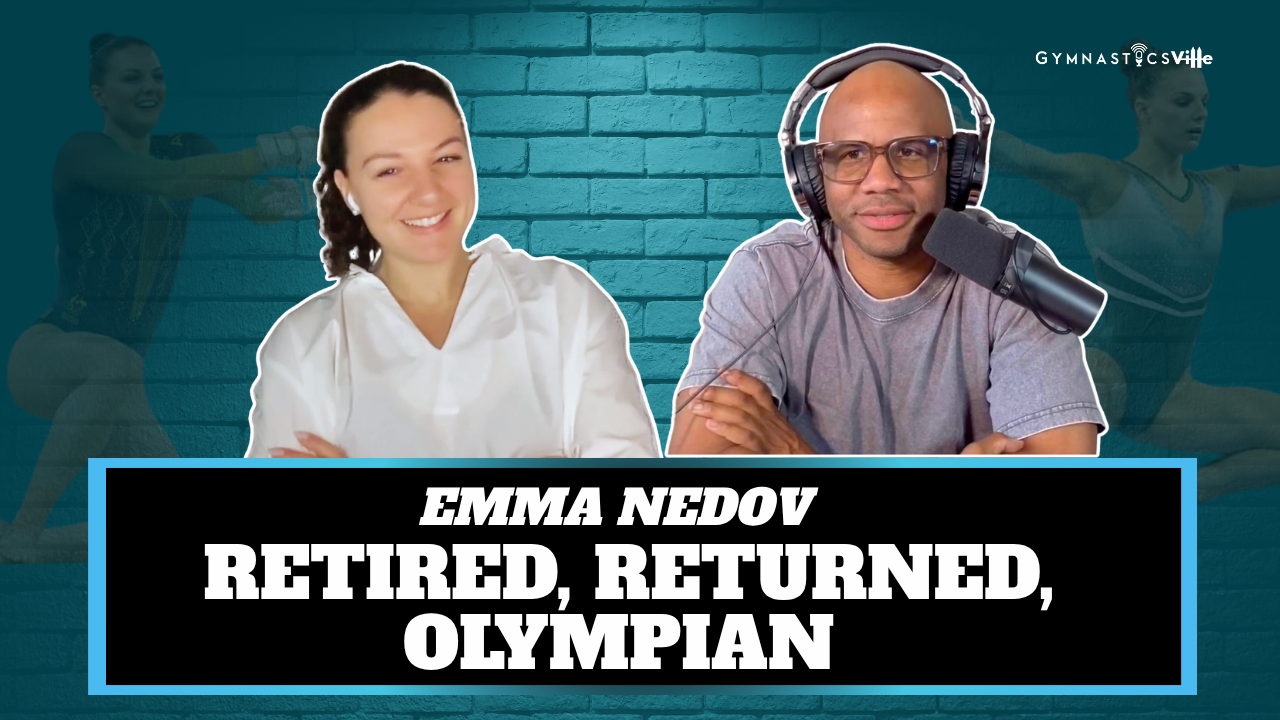
Emma Nedov retired from gymnastics at 24, convinced she was finished with the sport for good. Four years later, she walked out onto the Olympic floor in Paris representing Australia. The Emma Nedov gymnastics comeback is a story built on patience, trust, and a willingness to start over, and it did not end with the Games.
Emma, now a World Cup gold medallist on beam and a two-time Australian national beam champion, joined Back to Basics by GymnasticsVille to share how it all happened. She also explained why she is now building a community for the next generation through High Tea with Emma, a national event series for young gymnasts across Australia. Here is what stood out.
Emma Nedov at a Glance
- Australian Olympian, Paris 2024
- World Cup gold medallist on balance beam (Baku)
- Two-time Australian national beam champion
- Creator of High Tea with Emma, a national event series for young gymnasts
- Co-founder of ND Network and founder of NYRA (Not Your Regular Athlete)
After Retirement: “I Didn’t Love Being Ordinary”
When Emma finished up in 2020, she was relieved. She had spent 18 years in the sport, trained around 32 hours a week from the age of six, and missed out on Olympic opportunities because of circumstances outside her control. Stepping away felt like freedom.
Then everyday life set in. “I didn’t love being ordinary,” she says. Without a coach, a schedule, or a daily purpose, she felt she had lost what made her herself, and she struggled with the way her body and her sense of identity were changing.
Emma is open about that low point, and that honesty is a big part of why her story connects. Every elite athlete eventually faces the same question: who am I when the training stops?
Her way forward came through learning. She found a mentor who is a metabolic scientist, earned a nutrition certification, and spent roughly 2021 to 2023 coaching non-athletes on metabolic health. Working with executives over 40, she realized that everything she had learned in two decades of gymnastics still applied. None of it had been wasted.
That experience also planted a seed. Emma saw how little support exists for retired athletes, and she began thinking about how to help others through the same transition.
The Emma Nedov Gymnastics Comeback Starts With a Kip
In late 2023, the chance to train for the Olympics came up. Emma was honest about her mindset. She wanted to believe anything was possible, but she did not bet on making it. Her thinking was that working toward something extraordinary would lead to something extraordinary, whatever the result.
Then came day one. After more than three years away, she tried a kip on the low bar and her feet hit the ground. The brain-to-muscle memory simply was not there. Her coach had her start with basics like hopping off a box to check ankle stability, and she calls the first session very humbling.
Her coach gave it six weeks to find out whether a comeback was possible. About four weeks in, Emma was doing backhand springs on beam, her kip was back, and she could do two press handstands after starting with none.
“I think that we can do this.”
Emma Nedov, recalling what her coach said after four weeks back in training
From there, the road to Paris was about six months from trials and nine months from the Games. A third act that nobody, including Emma, was sure would happen became real.
Walking Into Paris at 28
Emma first represented Australia overseas at 13, and she admits she did not appreciate it at the time. By Paris, older and wiser, she wanted to be fully present and soak it all in.
Paris was also hard. Emma says she was not as strong gymnastically as she had been in her prime, so she leaned into a different role, supporting the younger gymnasts on the team and sharing the perspective her time away had given her. She jokes that she felt a little like a grandma at 28.
Her favorite memory is not a routine. Backstage before walking out into the Olympic stadium, she felt a lump in her throat and wanted to cry without knowing why. She compares it to the end of a feel-good movie. Once the team walked out and started on floor, she did what she always does and went into her bubble, but first she took a moment to look at the crowd and take in where she was.
Beam, Preparation, and Trust
Beam has been the thread running through Emma’s career, with two national titles and a World Cup gold in Baku. Her technique traces back to a YMCA in Sydney, where two coaches from the Chinese national team came into her gym when she was around 10 or 11.
The training was drill-heavy. She spent roughly two hours on beam and one hour on everything else, and she did drill after drill before ever touching the high beam. For a backhand spring, that meant foam blocks at her feet, between her legs, and on her head. For a front aerial, it meant around 30 repetitions from a height down to the floor, with chalk on her knee to make sure her technique was right.
The mental side took longer. Emma describes herself as a naturally cautious gymnast and an overthinker, technically flawless as a kid but not always at ease in competition. Working with her sports psychologist, she learned to make her preparation intentional.
That was the missing piece before Baku. Doing a lot of reps does not guarantee you trust them. By the time she got to the World Cup, she trusted her training, and you can see it in her routine. For gymnasts and coaches alike, the lesson is simple: reps matter, but intention is what turns reps into confidence.
High Tea with Emma: A Seat at the Table for Young Gymnasts
If the Emma Nedov gymnastics comeback is about what she achieved, High Tea with Emma is about what she is giving back. It started in a car.
After getting engaged, Emma stopped by the gym where she had trained with a group of young gymnasts in the lead-up to Paris. They wanted to see the ring and hear all about it. Sitting in the car afterward with her events and partnerships manager, she thought about how to keep those girls involved in what she was doing now, without leaving the gymnastics community she cares about.
There was another factor. As Emma explains, Australia has a government rule that keeps children under 16 off social media, and much of her audience, with participation peaking around ages 12 to 14, falls under that line. She wanted a way to share her lessons in person and help lift morale in Australian gymnastics. The name came out of her mouth in the car, and her partner loved it right away.
The idea came together in December and launched just after New Year’s. The first High Tea with Emma took place in Melbourne at the InterContinental, with catering and a decorated room. It was not designed to make money. Emma wanted tickets priced so that people who buy one genuinely want to be there, but not so high that it breaks the bank. As she puts it, “Gymnastics does that enough.”
Melbourne was a hit, so Sydney followed a month later, then Perth and Brisbane.
Athletes Only, Questions Welcome
Parents can drop their kids off and it is just the athletes. Emma says the young gymnasts are engaged, open to advice, and full of questions, and she did not know what to expect before the first one.
She also chose a tea room over a gym on purpose. In her words, training is the only time gymnasts normally get together, and once you stop training you lose that little community. High Tea gives them a place to talk about the sport they love without worrying about the next skill.
At the Brisbane event, Emma was joined by fellow Australian Olympian Ruby Pass, who she calls a little sister. That moment pointed to something bigger. Emma sees High Tea as a platform that today’s stars can eventually host for the next generation of twelve-year-olds looking up to them.
Next Stop: America?
Emma recently traveled to North America for a World YMCA council conference in Toronto, where she was attending because she serves on the board of a Melbourne regional YMCA. She then headed to the West Coast, and over about a week and a half she visited roughly eight gyms, speaking with athletes and coaches and testing whether her skill set translates in the United States.
When asked about bringing High Tea with Emma to the U.S., her answer was an immediate “100%.” For a woman whose own gymnastics journey began at a YMCA in Sydney, the connection is a fitting one.
Beyond the Gym: ND Network and NYRA
High Tea is one piece of a growing portfolio. ND Network is an athlete representation and management company Emma co-founded. The N stands for Nedov, and the D stands for Dave Diggle, her performance psychologist, whom she calls her “mindset guru.”
The idea is to support high-potential athletes who are not yet winning or carrying huge followings, helping them build their brand, improve their performance, and connect with sponsors. ND Network is starting with sports outside gymnastics, such as motorcycle racing and golf, because Emma sees them as more commercial in Australia. She describes High Tea with Emma as a proof of concept for the value athletes can bring beyond competition.
Then there is NYRA, which stands for Not Your Regular Athlete. It is a product business that begins with artistic gymnastics. Emma is developing four performance-based training tools, including toe shoes, wristbands, a dry brush, and underwear designed to be worn under a leotard.
Advice for Gymnasts Thinking About Stepping Away
We asked Emma what she would tell a young gymnast who loves the sport but is not sure she can keep going. Her answer started with a question: why do you feel that way? From there, she shared a few lessons from her own journey:
- Taking a step back is okay. Emma says she never took more than three days off as a teenager, and she wishes she had known that a breather was allowed.
- Know your intention. Understand what the sport is for you and what you want out of it.
- Whether you make it or not, the skills last. As Emma says, what you learn in gymnastics stays with you for life, and she encourages athletes to keep going while they figure out what is next.
Watch and Listen to the Full Conversation
Hear the full Emma Nedov gymnastics comeback story in her own words. You can watch the episode on the GymnasticsVille YouTube channel, or listen on Apple Podcasts and Spotify. Follow Emma on Instagram at @ejnedov and learn more at emmanedov.com.
Why the Emma Nedov Gymnastics Comeback Matters
The Emma Nedov gymnastics comeback is easy to summarize as retired, returned, and Olympian. What makes it special is everything underneath: a difficult stretch after the sport, a humbling first day back, a coach who believed, and an athlete who decided to turn her experience into something for the girls coming up behind her.
With High Tea with Emma, ND Network, and NYRA, Emma is proving that an athlete’s story can keep growing long after the competition ends. We cannot wait to see where she takes it next, including a potential trip to the United States.
Looking for more conversations like this? Browse the GymnasticsVille Podcast archive and our latest elite gymnastics coverage, or follow the college season with our perfect 10 tracker.
Follow GymnasticsVille on Instagram, and Facebook for breaking news and live meet coverage.