
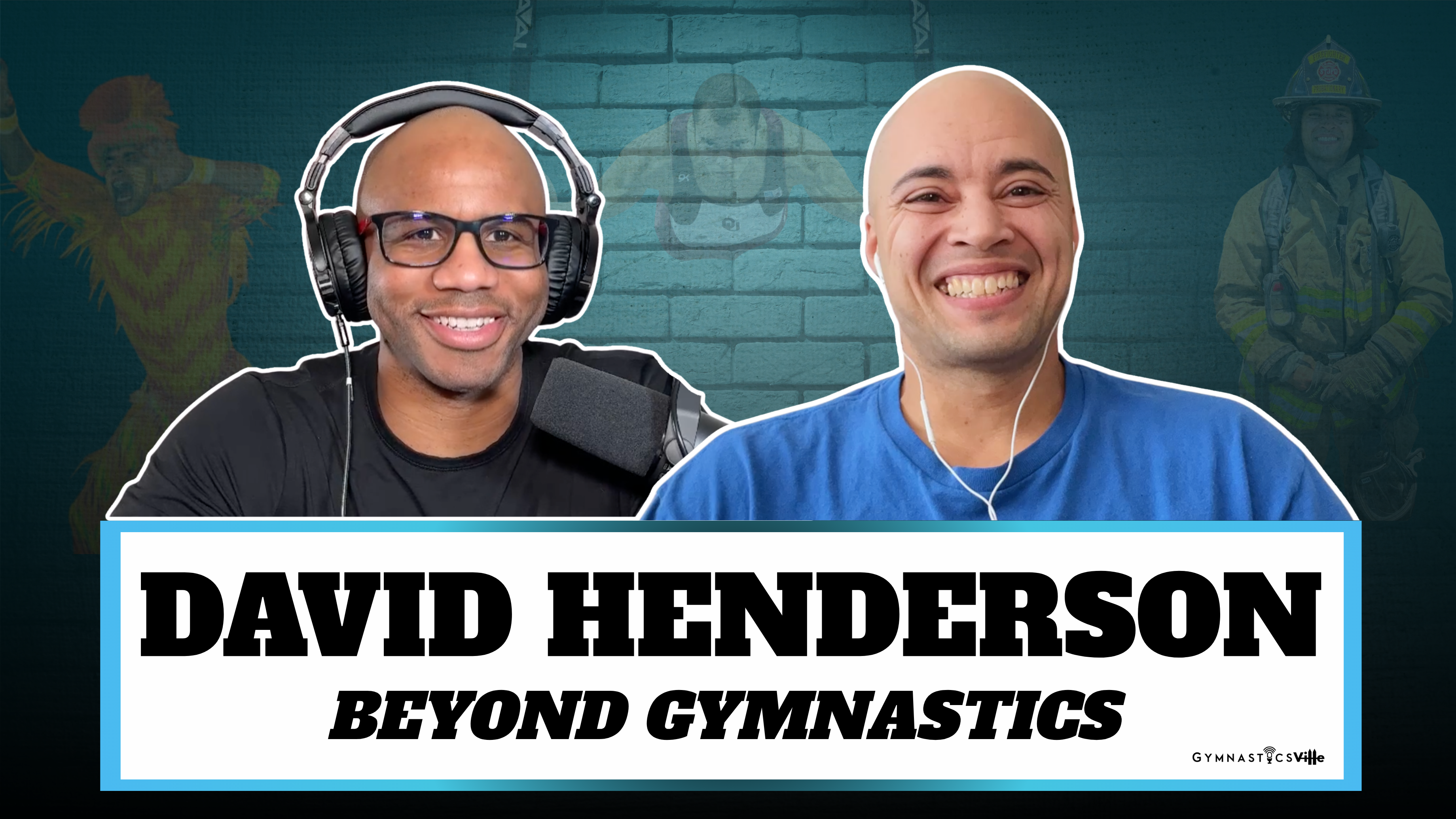
A four-time NCAA gymnastics champion reflects on Oklahoma’s championship culture, performing for Disney and Cirque du Soleil, and the lessons that prepared him for a new career as a firefighter.
That reply anchors the entire David Henderson Jr. gymnastics story. The sport, he told me, laid the foundation for who he is today, and it was the hardest challenge of all because “you’re constantly facing yourself.”
David is a four-time NCAA champion: three team titles with the University of Oklahoma and the 2005 individual still rings national championship. He is a former junior and senior U.S. national team member and one of my oldest friends. We trained together at Houston Gymnastics Academy (HGA), reunited as teammates at Oklahoma, and won the 2005 NCAA team title together. That history shaped our conversation on the GymnasticsVille Podcast, and it is why some of these stories are as personal as they are competitive.
David Henderson Jr. Gymnastics Roots: Houston Gymnastics Academy
David started gymnastics at 12 and moved to Houston at 15. At HGA he trained under Kevin Mazeika, who later served as U.S. Olympic men’s head coach, alongside a deep group of national and world team athletes. Looking back, David said those years may even outweigh his time at Oklahoma, partly because so many HGA teammates followed him to college.
Mazeika’s approach, as David remembers it, valued self-driven athletes who would chase their goals no matter who was in the gym. Words like accountability and integrity came up at every lineup, and David said he took them to heart. So did the rest of us.
“You gotta have serious fun. Or seriously have fun.”
That balance is what David remembers most. He has coached on and off over the years and still tells young gymnasts the same thing. The sport is hard enough, he said, and laughing at a silly fall, as long as the athlete can get up, takes the fear out of it.
One tradition captures the mix. Teammates held stick competitions on high bar, and a dismount did not count unless the landing stuck on the line of the folding mat. David recalled that they were throwing double doubles as juniors, a skill he called routine for today’s gymnasts but the big dismount of that era.
These days Mazeika is associated with EVO Gymnastics in Florida. David said the team videos coming out of EVO remind him of HGA: a cohesive group that challenges and supports one another. He recently reached out to tell Mazeika he is proud to be a product of that coaching.
Building a Championship Culture at Oklahoma
David was the first in our group to go to Oklahoma, and the rest of us followed. I will admit I barely knew they had a program until he went. Once I looked closer, I realized how serious college gymnastics was in Norman.
David Henderson Jr. gymnastics at Oklahoma began mid-year: he arrived at the start of the second semester of his freshman year and jumped straight into the season. The turning point, he recalled, came when Oklahoma hosted the NCAA Championships that year. A teammate nailed a vault, David went nuts celebrating, and he realized this team environment fit him more than he ever expected.
The adjustment was real. At HGA, Mazeika wrote the week’s workload on a board, and athletes chose how to get it done. At Oklahoma, under head coach Mark Williams, everything was a team assignment, and everyone rotated together.
“Fight for every single tenth.”
That was the principle, David said. Clean landings were a constant focus because the deductions add up, and he noticed that not every program treated them that seriously. If someone fell during a team event, the group went again.
David said Williams had a gift for building a team, mostly by asking more of everyone than they thought they had. The group did not leave an apparatus until the work was done, and that shared grind became its own kind of bond. Oklahoma won NCAA team titles in three of David’s four seasons and finished second in his junior year, as the two of us recalled. Everything pointed to one day, David said. The season was “fine tuning for that one moment,” team finals.
The 2005 NCAA Championship and the Meaning of Team Sacrifice
Two stories from the 2005 NCAA championship stayed with me after we stopped recording. Both are memories shared by two teammates nearly two decades later, so I will tell them the way we told them.
The Lineup Decision
Before team finals, my brother Taqiy came to our hotel room. His knees had limited him all season, but he thought he could contribute on floor. The lineup had been set the day before, and the floor spot belonged to Joe Weaver.
The hard part was Joe. Floor was the only event he was slated to compete at team finals, and the decision was his to make. David said the team gave Joe the chance to say he wanted to compete. Joe stepped aside.
When Taqiy warmed up, he nearly stuck every pass, and the energy of the whole team shifted. He hit his routine, maybe not his best, but strong for someone who had barely competed all year. We won by a narrow margin.
“What a heavy decision, man,” David said. Later he thanked Joe again for “making the sacrifice for the team,” adding: “He still gets the win.”
“I Would Die for All These Guys”
The second story belongs to David. Team finals ended on vault. As he stood at the end of the runway before his salute, he looked down the line at his teammates, and he remembers exactly what went through his mind.
“I would die for all these guys.”
He followed it with, “I’ll do anything it takes to land this vault right now.” He was clear that this was about commitment, not danger. In that moment, he said, he felt willing to sacrifice for the betterment of the team.
David said Williams’ training helped make that possible. One routine on game day was nothing compared with repeating it again and again in practice. And he has looked for that bond ever since. It showed up at Cirque, and it shows up now in the fire service, where, as he put it, “you gotta throw yourself literally into the fire to get somebody out.”
Life Beyond Competition: Disney’s Festival of the Lion King
After college, David spent three years as a resident athlete at the U.S. Olympic Training Center. When his body still felt good and he wanted to keep using what he had mastered, he sent a video to Cirque du Soleil. The company invited him to a four-month general formation, where athletes learn stage presence and dance and are placed in a specific act. David trained as a high bar flyer. No contract followed, so he went back to Texas and coached for about 11 months.
Disney came next. As he remembered it, he auditioned in early 2011 and started around May as a Tumble Monkey in Festival of the Lion King. I was in the Indiana Jones Epic Stunt Spectacular at the time, and Taqiy was in Lion King near the end of his run there. We helped David settle in and find an apartment.
David traced his comfort onstage to his father, a martial artist who performed demonstrations. What he loved about the show was its pace. “It was six minutes, it was all go from the beginning,” he said, and if you mess up, “you just keep moving.” He told me he still misses being on that stage.
Both of us agreed on the toughest adjustment for gymnasts: the apparatus no longer sits still. You have to feel a partner’s movement, remember choreography, and build trust. My first six months in Indiana Jones were rough. I messed up a show almost daily, including falls on my back, and I figured I was headed home.
David lasted about seven to nine months at Disney, by his recollection. Roughly three months in, Cirque called with a contract. Traveling with Cirque had been his goal, so he took it. Fans of this side of the sport may also enjoy our conversation with Trevor Howard, another gymnast who performed at Disney.
Inside Cirque du Soleil: Performance, Precision, and Trust
David joined the European tour of Corteo first, then spent a year in Totem. In both shows he was a flyer on high bar, an act in which multiple performers share connected bars and must time their giants together. As he remembered it, the act could involve a dozen or so athletes.
It took him longer to adjust than Disney had, because he had to stop his own rotation and launch in sync with others.
“If you’re off, bail.”
That was the biggest cultural difference. In competition, a gymnast fights to the end and takes one for the team. At Cirque, with people’s safety on the line, the rule was the opposite: do not try to be a hero.
David also described how a production runs: a head coach oversees the show, each act has a captain, and arena tours, with a new city every week, offered far more stage time than the big top.
His Cirque career was not continuous. He left for about four years to coach in Austin and raise his family, then returned. Overall, he estimated that his association with Cirque spanned 12 to 14 years, off and on.
Learning to Have Bad Days
How Cirque du Soleil Taught an NCAA Champion to Accept Imperfection
This may be the most relatable part of the interview, for athletes and for anyone else. David was candid about his emotional side in gymnastics. When he missed, he said, he could throw a fit, and he once got kicked out of the gym for his language. He wanted it that badly, and he admitted he was also immature about it.
Cirque changed that. At the general formation, he said, “I learned how to learn.” Later, as a working performer, he said he “learned how to have bad days.” The coaches told him a poor session did not mean he was failing, and that he would be back to train tomorrow because this was the job now.
“Let’s do the best we can with what we have for the day.”
That became his approach. If he was sore, or his timing was off, he worked with what he had. His training got more productive, and he enjoyed the process more. In his competitive days, he told me, he feared that if he could not do something now, he could not do it on competition day.
He also credited Taqiy and me, kindly, for showing him another way. Watching us, he learned that recovery matters. “Honestly, pull back, do a little less,” he said, because sometimes the mind needs time to recalibrate.
From the High Bar to the Firehouse
Why firefighting? David said he needed a transition out of gymnastics, something more stable that would let him provide for his three daughters, and a profession that would keep him learning and serving his community. Joseph Hagerty, a former teammate whom David described as an Olympic bronze medalist, had spent several years firefighting in Albuquerque and told him it was the greatest job on the planet.
At the time of our interview, David had been on the job for under a year. He went through a six-month recruit school that he never wants to repeat but is glad he completed. The protective gear adds 50 to 75 pounds, and he trained through a South Carolina summer, climbing ladders with no mats below and entering live burns where he could not see, breathing from an air tank, searching for a simulated victim.
“Learning how to be comfortable with being uncomfortable.”
That, he said, is what carried over from gymnastics, along with “how to stay calm regardless of what’s happening.” Each repetition got easier.
He was careful to separate drills from the real thing. On actual calls, he said, he has been surprised by how calm he stays, even though some veteran colleagues get worked up. He credited his conditioning in performing under stress.
The Lessons That Last Beyond Gymnastics
As a father and a coach, David has come to believe that example matters more than instruction.
“You don’t teach your kids anything, you simply give them what you are.”
Near the end, I asked what he was most grateful for from the sport. He took a moment and then said, “Man, I love gymnastics so much.” It gave him confidence and a way to measure everything else. Whatever he faces now, he can compare it to something that challenged him more in gymnastics, and he knows there is a process to work through it.
Like his father, who saw no difference between martial arts and life, David sees gymnastics the same way. Then he put it simply: gymnastics “was everything to me.”
That, to me, is the heart of this series. The David Henderson Jr. gymnastics story shows how many directions the sport can lead, and we will keep telling them through our athlete profiles.
Watch the Full GymnasticsVille Interview
There is much more in the full conversation, including more Oklahoma stories, more from the Cirque stage, and some laughs about our days at HGA. Watch the complete David Henderson Jr. gymnastics interview on YouTube starting Friday, Oct. 30, and follow David on Instagram at @dhjr369.
Subscribe to GymnasticsVille for future stories on gymnastics, professional entertainment, and life beyond competition, and keep up with the college game in our NCAA Perfect 10 Tracker.
Follow GymnasticsVille on Twitter, Instagram, and Facebook for breaking news and live meet coverage.